

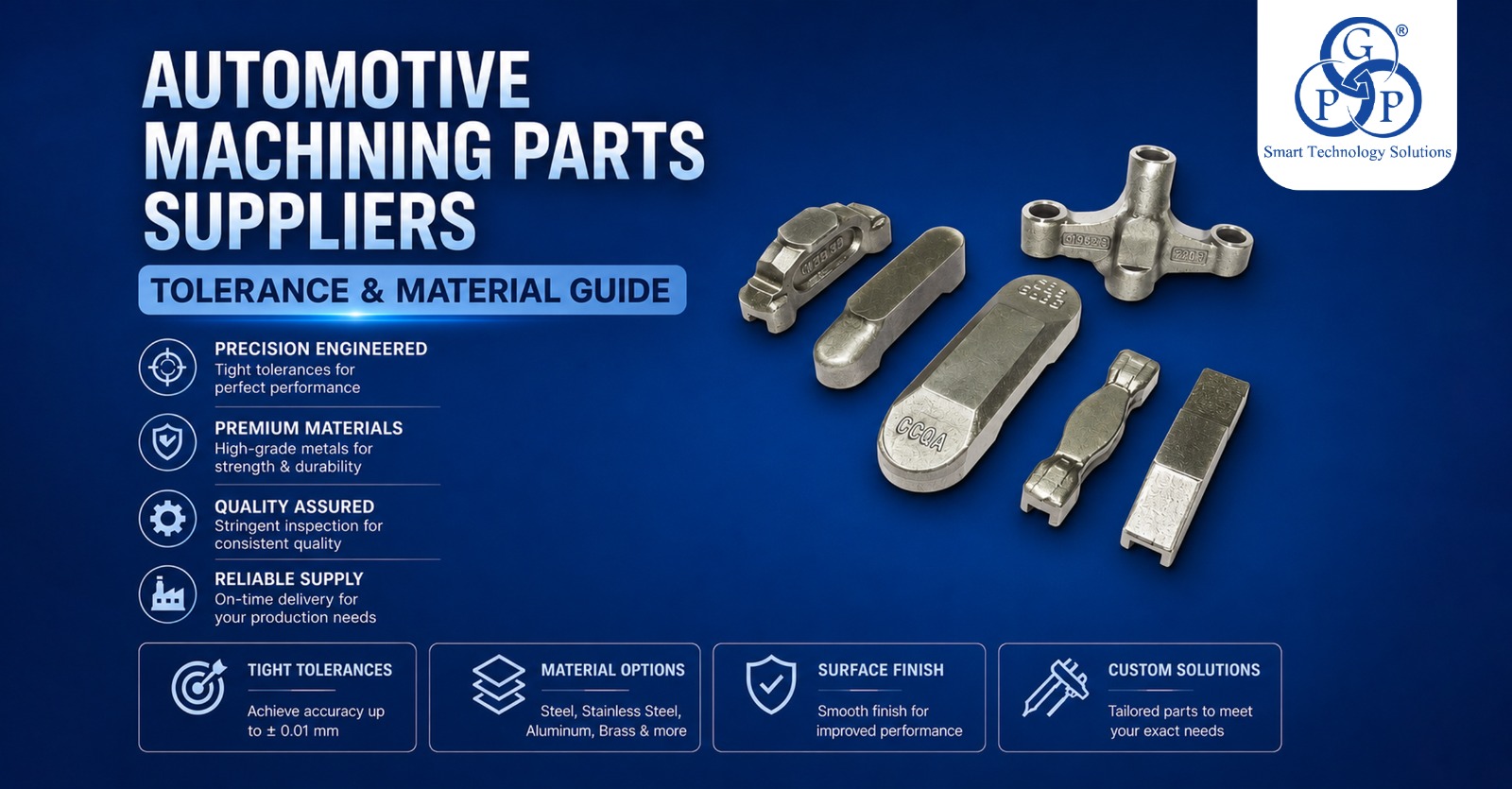
The automotive industry runs on precision. Every component, from the smallest engine push rod to complex chassis assemblies, must meet exact specifications to ensure safety, performance, and durability. This is where automotive machining parts suppliers play a critical role.
Whether you are manufacturing conventional internal combustion engine vehicles, transitioning to electric mobility, or even building agricultural drones, the quality of machined components determines the success of your product. In this comprehensive guide, we will explore everything you need to know about machining tolerances, material selection, and how to choose the right partner for your precision manufacturing needs.
At GPP India, we have been delivering world-class precision engineering solutions since 1988. With five cutting-edge manufacturing facilities across India and over 37,500 square meters of advanced infrastructure, we specialize in High Precision Machining for Automotive Industry and beyond.
Machining tolerances define the allowable variation in a part's dimensions. In simple terms, they determine how much a manufactured part can deviate from its exact design specifications while still functioning correctly. For automotive components, these tolerances are extremely tight because even minor deviations can affect assembly, performance, or safety.
Think of it this way: if a piston is even slightly too large or too small, the engine may fail to operate properly. If a valve train component is off by a fraction of a millimeter, the entire engine performance could be compromised.
Several international and industry-specific standards govern machining tolerances in the automotive sector:
ISO 2768 is the most widely referenced standard for general machining tolerances. It is divided into two parts:
For example, a drawing specifying "ISO 2768-mK" means the component must adhere to medium tolerance for dimensions and class K for geometric features. For critical automotive applications, manufacturers often demand ISO 2768-fH, the tightest class.
IATF 16949 is the world's most demanding quality management standard specifically designed for the automotive supply chain. It enforces a zero-defect culture and customer-specific requirements.
ISO 9001 establishes a disciplined foundation for high-precision production through documented verification and continuous evaluation.
GD&T (Geometric Dimensioning and Tolerancing) follows ASME Y14.5 principles to ensure components meet exact design specifications and functional requirements.
Standard automotive tolerances can range from ±0.1mm to ±0.5mm for general features. However, critical components demand much tighter precision:
| Component Type | Typical Tolerance Range | Standard Reference |
|---|---|---|
| Engine blocks (high-precision zones) | ±0.05 mm | QC/T 266-2025 |
| Transmission components | ±0.01 mm to ±0.025 mm | ISO 286-1 |
| Connector pins | ±0.005 mm | Industry standard |
| Bearing surfaces | ±0.05 mm | GB/T 42124.3-2025 |
| General features | ±0.1 mm to ±0.5 mm | ISO 2768 |
| Ultra-precision applications | ±0.001 mm to ±0.005 mm | ISO 13485 |
Safety-critical parts such as brakes, steering components, and engine internals demand the tightest tolerances. However, there is a cost trade-off: tolerances beyond ±0.02mm exponentially increase production costs. This is why working with experienced automotive machining parts suppliers who understand this balance is essential.
At GPP India, we employ Coordinate Measuring Machines (CMMs) for dimensional accuracy, ensuring every component meets or exceeds specified tolerances. Our commitment to Six Sigma practices and real-time SPC monitoring guarantees consistency across millions of parts.
Choosing the right material is just as critical as meeting tolerance specifications. The material determines the component's strength, weight, durability, corrosion resistance, and machinability.
Steel remains the most widely used material in automotive machining due to its exceptional strength and durability.
Key Characteristics:
Common Applications:
Types of Steel Used:
Aluminum is the most commonly used non-ferrous metal in machining. It offers an excellent strength-to-weight ratio and is relatively easy to machine.
Key Characteristics:
Common Applications:
Popular Aluminum Grades:
Cast iron offers excellent vibration dampening and wear resistance.
Key Characteristics:
Common Applications:
When choosing materials for CNC machining, manufacturers must evaluate:
| Material | Strength | Weight | Corrosion Resistance | Machinability | Primary Applications |
|---|---|---|---|---|---|
| Carbon Steel | High | Heavy | Low | Good | Engine parts, frames |
| Stainless Steel | High | Heavy | Excellent | Moderate | Harsh environments |
| Aluminum 6061 | Moderate | Light | Good | Excellent | General automotive |
| Aluminum 7075 | High | Light | Good | Good | Aerospace, racing |
| Cast Iron | High | Heavy | Moderate | Good | Heavy-duty components |
High Precision Machining for Automotive Industry requires a combination of advanced technology, skilled workforce, and rigorous quality control. At GPP India, we deliver on all three fronts.
State-of-the-Art Infrastructure:
Our state-of-the-art infrastructure includes:
Quality Control:
Our rigorous quality control processes include:
Certifications:
GPP India specializes in:
With a production capacity of over 12 million push rods annually, GPP India is recognized as a market leader in valve train components.
The automotive industry is undergoing a massive transformation toward electrification. As an Electric Mobility Solutions Provider, GPP India is at the forefront of this revolution.
Electric vehicles introduce new components with demanding machining requirements. Key EV components include:
GPP India offers comprehensive Electric Mobility Solutions including:
EV components require the same – if not higher – levels of precision as traditional automotive parts. For example:
As the India Electric Vehicle Components market is forecast to grow at a CAGR of 37.4%, reaching USD 16,386.9 million by 2031, the demand for reliable Electric Mobility Solutions Providers will only increase.
The agricultural sector in India is embracing drone technology for precision farming, crop monitoring, spraying, and land surveying. As an Agri – Drone Manufacturer India partner, GPP India supports this growing industry with precision-machined components.
India started adopting agricultural drones about seven to eight years ago. Today, numerous companies are manufacturing drones in-house rather than importing knockdown versions for assembly.
The government's Drone PLI scheme is pushing 100+ companies to manufacture locally. This has created significant demand for precision-machined drone components.
Agricultural drones require various precision-machined components:
CNC cutting machines and grinding machines are essential for manufacturing drone airframes and chassis. The focus is on achieving lightweight durability and field resilience.
With CNC machining, manufacturers can achieve high precision while maintaining the lightweight characteristics required for drone applications.
GPP India leverages its precision machining expertise to support Agri – Drone Manufacturer India companies with high-quality, precision-engineered components.
Selecting the right partner for your precision machining needs is crucial for your business success. Here are key factors to consider:
Does the supplier have modern CNC machines, heat treatment facilities, and comprehensive inspection capabilities? GPP India operates five cutting-edge advanced manufacturing facilities with state-of-the-art technology.
Look for certifications like IATF 16949, ISO 9001, and industry-specific standards. GPP India holds IATF 16949, ISO 45001, ISO 14001, AS9100-D, and VDA 6.3 certifications.
How long has the supplier been in business? What is their track record? GPP India has been delivering precision engineering solutions since 1988 and is a globally recognized powerhouse in precision engineering.
Can the supplier meet your volume requirements? GPP India produces over 12 million push rods annually.
Does the supplier have robust quality control processes? GPP India employs CMMs, tensile testing machines, eddy current sorters, and metallurgical microscopes for comprehensive quality assurance.
Can the supplier handle custom specifications and complex geometries? GPP India offers custom precision machined components for engines, hydraulics, and suspensions.
What do other customers say? GPP India is recognized as a market leader in valve train components and a trusted supplier to global OEMs.
GPP India stands out as a preferred partner for automotive machining for several reasons:
Decades of Experience: Since 1988, we have been delivering precision engineering solutions to global customers.
Comprehensive Capabilities: From precision forgings and precision castings to high-precision machining and assembly, we offer end-to-end solutions.
World-Class Infrastructure: Our five manufacturing facilities are equipped with state-of-the-art machinery and technology.
Rigorous Quality Control: We employ advanced testing and inspection equipment to ensure every component meets specifications.
Customer-Centric Approach: We work closely with our customers to understand their requirements and deliver tailored solutions.
Global Recognition: We are a trusted supplier to leading OEMs across the automotive, aerospace, and industrial sectors.
The automotive industry demands precision, reliability, and consistency. Whether you need High Precision Machining for Automotive Industry components, EV solutions, or drone parts, choosing the right automotive machining parts supplier makes all the difference.
GPP India combines decades of experience, state-of-the-art technology, rigorous quality control, and comprehensive capabilities to deliver world-class precision engineering solutions. From valve train components to EV powertrain systems, from castings to custom CNC machined parts, we are your trusted partner for precision manufacturing.
Contact GPP India today to discuss your precision machining requirements.
ISO 2768 is an international standard that provides guidelines for general tolerances in technical drawings. It simplifies mechanical tolerance specifications and ensures compatibility across industries. For automotive machining, ISO 2768 provides a baseline for non-critical features, while critical components often require tighter, explicitly stated tolerances.
The most commonly used materials include aluminum, steel, stainless steel, cast iron, and titanium. Aluminum is popular for its lightweight and excellent machinability, while steel offers superior strength and durability. Engineering plastics like ABS, nylon, Delrin, and PEEK are also used for specific applications.
Standard automotive tolerances range from ±0.1mm to ±0.5mm for general features. Critical components like engine or transmission parts often require ±0.01mm to ±0.025mm or better. Ultra-precision applications may demand tolerances as tight as ±0.001mm to ±0.005mm.
IATF 16949 is the world's most demanding quality management standard specifically designed for the automotive supply chain. It enforces a zero-defect culture, customer-specific requirements, and first-time quality expectations.
GD&T (Geometric Dimensioning and Tolerancing) ensures components meet exact design specifications and functional requirements. It defines the exact relationships between surfaces, ensuring that every gear, piston, and housing performs under tough conditions with minimal error.
Key EV components requiring precision machining include motor housings, battery trays, end covers, stators, rotors, gear cases, rotor shafts, and CV joints. These components demand high surface finish and part quality.
GPP India employs Coordinate Measuring Machines (CMMs) for dimensional accuracy, tensile testing machines for material strength validation, eddy current sorters for defect detection, and metallurgical microscopes for microstructure analysis. The company also follows Six Sigma practices and real-time SPC monitoring.
GPP India specializes in valve train components (push rods, rocker arms, rocker shafts, tappets), hydraulic lash adjusters, engine brake systems, chassis components, precision castings and forgings, and EV powertrain systems.
GPP India has been delivering precision engineering solutions since 1988, operates five cutting-edge manufacturing facilities, holds multiple international certifications including IATF 16949, and produces over 12 million push rods annually. The company combines advanced technology, skilled workforce, and rigorous quality control.
Steel offers higher mechanical strength and durability, making it ideal for load-bearing and high-stress applications. Aluminum is about three times lighter than steel and offers excellent corrosion resistance, making it ideal for lightweight applications like aerospace, automotive structures, and drone components.
automotive machining parts suppliers, high precision machining for automotive industry, electric mobility solutions provider, agri-drone manufacturer India, CNC machining tolerances, ISO 2768, IATF 16949, GD&T standards, automotive material selection, precision engineering India, GPP India, valve train components, EV powertrain manufacturing, custom CNC machining, automotive parts supplier