

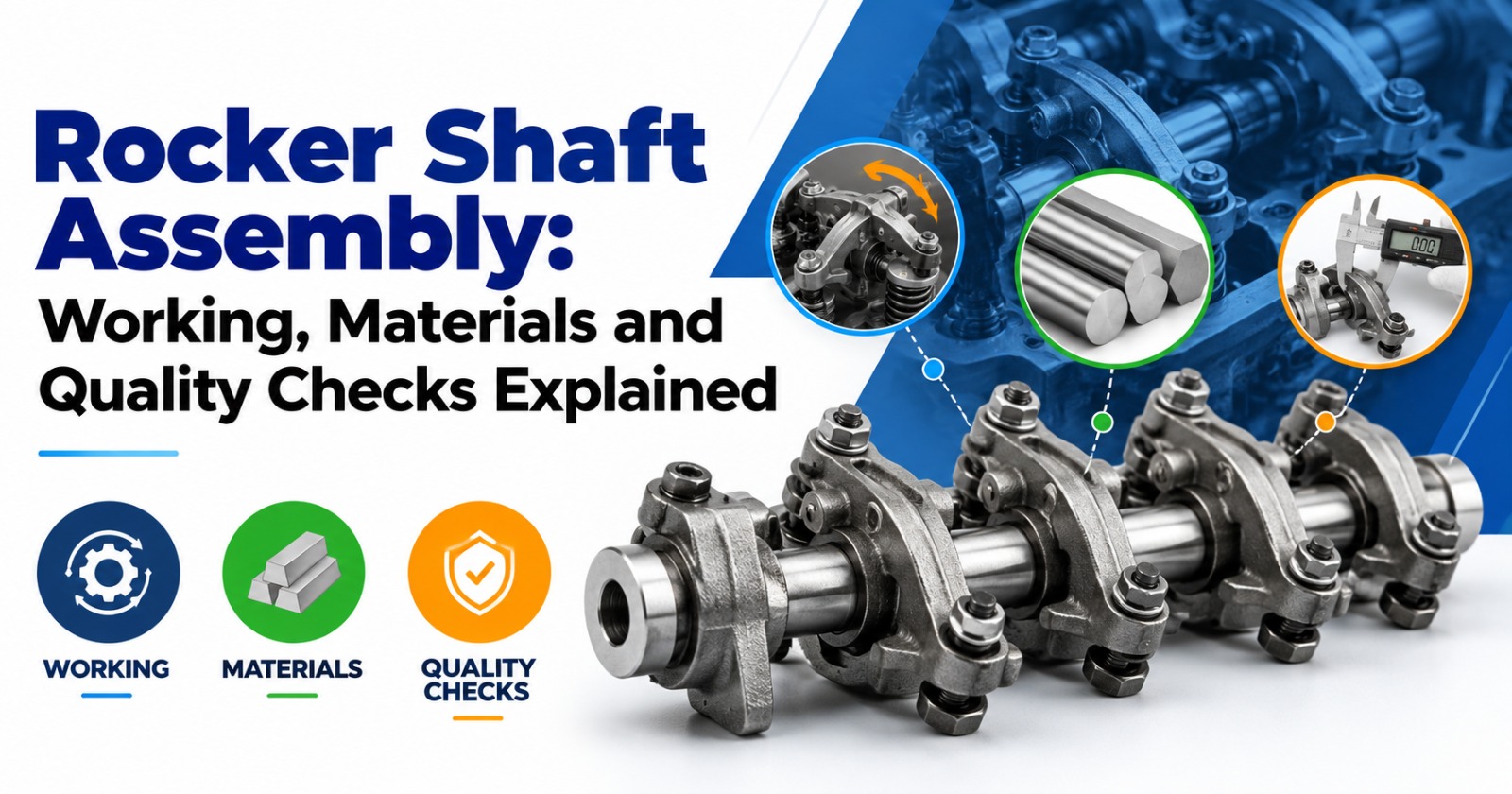
A rocker shaft assembly is the pivot system in an overhead valve engine. A hardened shaft carries the rocker arms on brackets above the cylinder head, and it often feeds oil to each pivot. Quality depends on shaft straightness, hardness, surface finish, rocker arm bore size and oil hole position. Ask a supplier for drawing conformance and the records that your specification requires.
A rocker shaft assembly is the pivot system in an overhead valve engine. A hardened shaft runs through the rocker arms and is mounted on brackets over the cylinder head. The push rod pushes one end of each rocker arm, and the other end presses on the valve or on a valve bridge.
If the assembly is not accurate, valves can open late, close hard or wear the guide quickly. The range is shown on the rocker shaft assemblies page.
| Part | Function | Quality Focus |
|---|---|---|
| Rocker shaft | Acts as the pivot and often carries oil to the arms | Straightness, hardness, surface finish |
| Rocker arm | Turns push rod lift into valve movement | Profile accuracy, bore size, wear surface |
| Bracket / support | Holds the shaft on the cylinder head | Flatness and bolt hole position |
| Spring and spacer | Keeps arms in position along the shaft | Free length and load |
| Oil holes | Feed lubricant to the pivot points | Position and clean drilling |
The shaft is typically made from steel that can be surface hardened. After machining, it is hardened and ground to a close diameter tolerance, and the bearing surface is finished to the roughness specified on the drawing.
Grade, hardness, case depth and diameter limits come from the engine drawing. Ask the supplier how each is verified for your part, and which records are provided.
In many engines oil reaches the rocker arms through the hollow shaft, and small drilled holes feed each pivot. If one hole is blocked or misplaced, that rocker arm runs dry and wears quickly.
Oil hole position and cleanliness therefore belong in the inspection plan. A quick flow check with clean oil or air before assembly can reveal a blocked passage.
Which checks apply depends on the drawing, control plan and customer specification. Typical points to discuss are:
Frameworks such as ISO 9001 and IATF 16949 give a common structure for how a supplier controls and records these checks.
A worn assembly often shows up as clattering at idle, uneven valve lift or oil starvation at the rocker arms. With the cover removed, you may see scoring on the shaft or a loose rocker arm fit.
A new rocker arm on a worn shaft wears quickly. Measure shaft diameter and bore clearance against the engine maker's limits, and follow the service manual on whether to replace parts together.
Fit the assembly with clean parts and fresh oil on the pivots. Follow the torque values and tightening order given by the engine maker, because uneven tightening can bend the shaft or distort the brackets. After fitting, set valve lash and turn the engine by hand to confirm free movement.
If push rods and valve bridges are also worn, check them at the same time, since the parts wear as one system.
Ghaziabad Precision Products (GPP) was established in 1988 and operates five manufacturing facilities in Ghaziabad, Uttar Pradesh, with a combined footprint of approximately 37,500 sq. m. Its capabilities include forging, precision machining, heat treatment and finishing. The facilities page describes the equipment and processes in more detail. GPP supplies components to OEM and Tier-1 customers, and the clients page shows the sectors it serves.
Rocker shaft assemblies are part of GPP's valve train range and are manufactured to customer drawings and applicable specifications. Engine makers in Delhi-NCR and across India can also review the plant through a visit or audit, which helps when tolerances must stay stable across large batches.
| GPP Capability | Buyer Benefit |
|---|---|
| Established in 1988 | A long operating history to review during supplier assessment |
| Five manufacturing facilities, approx. 37,500 sq. m. | A manufacturing network whose capacity can be discussed against your volume |
| Forging, precision machining, heat treatment and finishing | Process stages relevant to shaft hardness, diameter and surface finish |
| Rocker shaft assemblies with push rods, valve bridges and tappets | Matched valve train parts from one manufacturer |
| Ghaziabad, Delhi-NCR base | Accessible for audits and sample discussions |
It is the shaft, rocker arms and brackets that pivot to open and close the engine valves in an overhead valve engine. The shaft acts as the pivot and often carries oil to the arms, while the brackets hold the assembly on the cylinder head.
The push rod lifts one end of the rocker arm. The arm pivots on the shaft and presses the valve, or a valve bridge, open at the other end. The valve spring then closes the valve as the cam lobe rotates away.
Look for clattering at idle, uneven valve movement, low oil flow at the rocker arms and visible scoring on the shaft. These signs can have other causes, so remove the cover and measure the clearances against the engine maker's limits to confirm.
Steel that can be surface hardened is the usual choice. The shaft is ground to a precise diameter and finished for smooth contact with the rocker arm bores. The grade, hardness and tolerances are defined by the engine drawing. Ask the supplier to confirm the grade against its certificate.
Oil lubricates and cools the pivot points between the shaft and the rocker arms. A blocked or misplaced oil hole leaves one arm without lubrication, which causes rapid wear and noise. Checking oil hole position and cleanliness is part of a sound inspection plan.
Follow the engine maker's service manual. If clearance between shaft and bore is out of limit, fitting new arms on a worn shaft shortens the life of both. Measuring the clearances at overhaul shows which parts need replacement. Check neighbouring parts too.
It depends on the engine design. Diameter, straightness and surface finish are held to the limits on the drawing, and the matching rocker arm bore limits set the running clearance. Ask the supplier how these characteristics are measured and recorded for your part.
Regrinding is sometimes possible, but only within the engine maker's limits, and only if enough hardened case remains after grinding. Check the service manual first. If the limits are not met, replacing the shaft is the safer route. Never regrind below the specified limits.
Rocker shaft assemblies are part of GPP's product range, supplied to OEM and Tier-1 customers. To discuss a requirement, send your drawing, material grade, annual volume and technical requirements through the GPP contact page. Volumes and schedules are discussed per requirement.
The reliability of a rocker shaft assembly comes down to a few measurable points: shaft straightness and hardness, bore clearance and oil path. Ask a supplier how each is controlled for your drawing, and approve samples before volume supply.
For drawings, samples or volume discussions, use the contact page and include your material grade, annual volume and technical requirements. The full product range is available to browse first.