

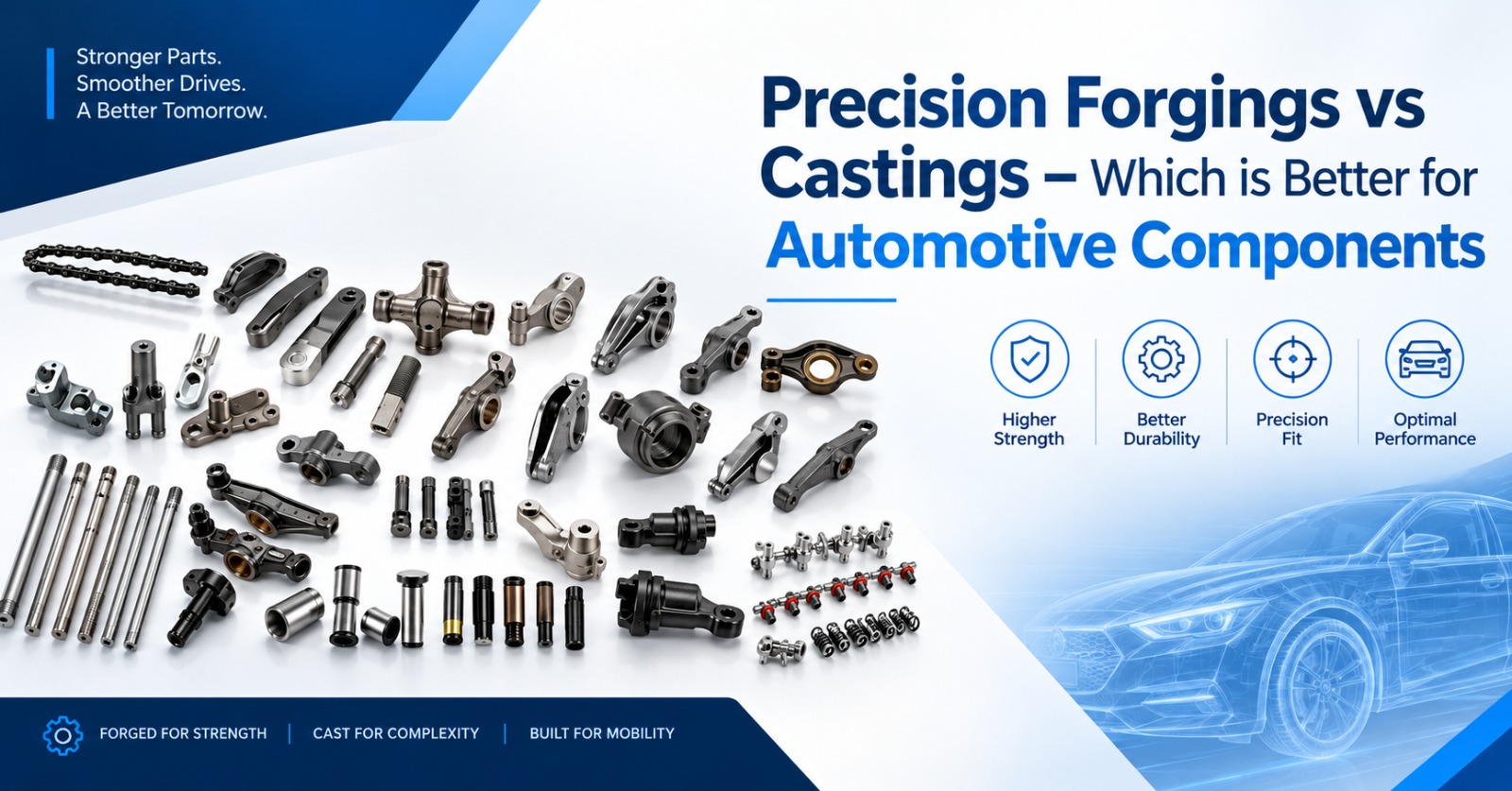
Every car, truck, and bus runs on metal parts. But not all metal parts are made the same way. Two common methods are forging and casting. Both have been around for decades. But which one gives you better automotive parts?
This question matters to mechanics, fleet owners, and parts buyers. Pick the wrong type, and your part may break early. Pick the right type, and your engine runs for years.
This guide explains forging and casting in simple words. You will learn the strengths and weaknesses of each. You will also see why GPP India is a trusted Industrial Precision Forgings Manufacturer.
Forging is shaping hot metal by hammering or pressing. Imagine a blacksmith heating a metal rod and hitting it with a hammer. Modern forging uses giant presses and hammers. But the idea is the same.
The hammering aligns the metal grains. This makes the part stronger. Forged parts have a grain flow that follows the shape of the part. That is why Forged Auto Parts India are known for strength.
Casting is pouring molten metal into a mold. The liquid metal fills the mold shape. Then it cools and becomes solid. Think of making ice cubes. You pour water into a tray and freeze it. Casting is similar but with hot metal.
Casting can make complex shapes easily. But the metal grains do not align in any special direction. This makes cast parts weaker than forged parts of the same material.
|
Feature |
Forging |
Casting |
|
Metal Grain Flow |
Aligned with part shape |
Random direction |
|
Strength |
Very high |
Moderate |
|
Impact Resistance |
Excellent |
Good but can crack |
|
Porosity (Holes) |
Almost none |
Possible internal holes |
|
Complex Shapes |
Limited |
Very good |
|
Tooling Cost |
High |
Medium to high |
|
Production Speed |
Fast for large runs |
Medium to fast |
|
Best For |
High stress parts |
Complex shapes |
Car and truck parts face constant stress. Engine parts get hammered thousands of times per minute. Suspension parts hit potholes and bumps. Gearbox parts handle high torque.
A weak part fails. Failure means breakdowns, repair costs, and lost time.
This is why many Commercial Vehicle Engine Parts India buyers choose forged parts. A forged connecting rod or crankshaft handles more stress than a cast one.
Electric vehicles are different from diesel trucks. But they still need strong parts. An EV Powertrain Manufacturer needs gears, shafts, and differential parts. These parts face instant torque from the electric motor.
Instant torque means sudden force. Cast parts can crack under sudden force. Forged parts handle it better.
For EV Powertrain System Components, forging is often the safer choice. The reduction gearbox and differential need forged gears. A good Powertrain Components Supplier knows this.
Do not think casting is useless. It is not. Casting is perfect for certain parts.
Engine blocks are often cast. Cylinder heads are cast. Brake calipers and intake manifolds are cast too. These parts have complex internal passages. Casting makes them easily.
A Precision Castings Manufacturer can make parts that are strong enough for many applications. Not every part needs the highest strength. Sometimes cost and shape matter more.
Not every forging shop gives quality. Here is what to look for:
|
Quality Check |
Why It Matters |
|
Steel grade control |
Wrong steel means weak parts |
|
Proper heating temperature |
Too hot or too cold ruins grain structure |
|
Accurate dies |
Wrong shape means bad fitment |
|
Heat treatment after forging |
Removes internal stress and adds hardness |
|
Dimensional inspection |
Ensures every part matches specifications |
|
Surface finish check |
Cracks or folds mean rejected part |
A real Industrial Precision Forgings Manufacturer like GPP India follows all these steps.
GPP India has years of experience in precision manufacturing. They understand what makes a good forged part. Their process includes:
Every part leaving their factory is tested. No guesswork. No shortcuts.
For customers looking for Forged Auto Parts India, GPP India delivers reliability. They serve the commercial vehicle, tractor, and industrial equipment markets.
India is moving toward electric vehicles. Electric Vehicle Components India need to be both strong and light.
Forged parts are stronger for the same weight. This means you can use less material and still get good strength. Less weight means more range for the EV.
A cast part needs more material to match forged strength. More material means more weight. More weight means less range.
For EV makers, every kilogram matters. That is why many choose forging.
Myth 1: Casting is always cheaper
Not true. For large production runs, forging can be cheaper per part. Tooling costs are high but spread over many parts.
Myth 2: Forged parts are always heavy
False. Forged parts are dense but not necessarily heavy. You can design thin forged parts because the material is strong.
Myth 3: Casting quality is always bad
Wrong. Good foundries make excellent cast parts. The difference is consistency. Forging gives more consistent quality.
Here is simple advice:
Choose forging for:
Choose casting for:
If you are unsure, ask a Powertrain Components Supplier like GPP India. They can guide you based on your exact need.
Forging dies cost more than casting molds. But forged parts need less inspection and have fewer rejects. Cast parts may have hidden porosity. Finding those defects costs money.
Over the lifetime of a part, forging often costs less. Fewer failures mean fewer warranty claims. Fewer breakdowns mean happier customers.
Both forging and casting have their place. Neither is always better. The right choice depends on your part shape, stress level, and budget.
But for high-stress automotive parts, forging wins. The grain flow, strength, and reliability of forged parts are hard to beat.
GPP India stands ready as your Industrial Precision Forgings Manufacturer. They make Forged Auto Parts India that you can trust. Whether you need parts for commercial vehicles, electric vehicles, or industrial equipment, contact GPP India.
Do not gamble with weak parts. Choose forging. Choose strength. Choose GPP India.
Forging shapes hot metal by hammering. Casting pours molten metal into a mold. Forging aligns metal grains for extra strength.
Forged parts are stronger. The hammering aligns metal grains along the part shape. Cast parts have random grain direction.
For low-stress applications, yes. For engine and suspension parts, forged is better. Cast parts can have hidden holes called porosity.
Trucks and buses face high stress every day. Forged parts handle more load without breaking. That means fewer breakdowns.
Yes. GPP India has years of experience, modern machines, and strict quality testing. Every part is inspected before shipping.
Gears, shafts, differential parts, and reduction gearbox components. These face instant torque from the electric motor.
Tooling costs are higher. But per-part cost can be similar for large runs. Forged parts also cause fewer warranty claims.
Look for material testing, mold accuracy, and defect inspection. Ask for samples before bulk orders.
Grain flow is the direction of metal crystals after hammering. Good grain flow follows the part shape. This adds strength.
GPP India uses high-grade steel, controlled heating, precision dies, and 100% inspection. You get consistent quality every time.