

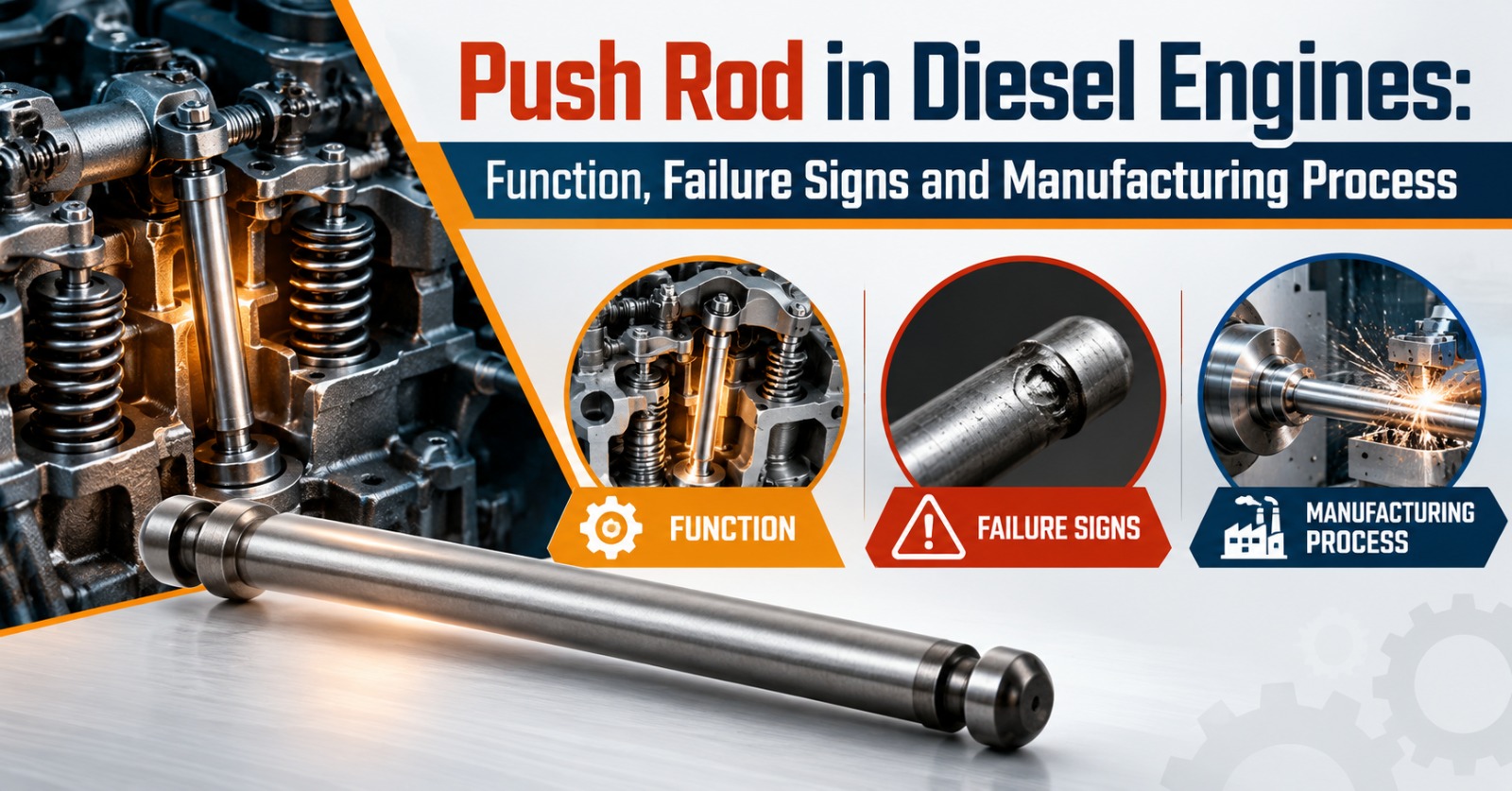
A push rod transfers motion from the tappet to the rocker arm in an overhead valve engine, so the valve opens and closes on time. It must be straight, stiff and hardened at the ends. Ticking noise, a misfiring cylinder, power loss or worn rod ends can indicate a problem. Check straightness and end wear at overhaul, and ask a manufacturer for drawing conformance, material and hardness documentation.
A push rod is a long, slim rod that sits between the tappet and the rocker arm. When the camshaft lifts the tappet, the rod passes that lift upward and tilts the rocker arm, which opens the valve.
The part has two competing requirements. It must be light enough to follow fast valve motion and stiff enough not to bend. In heavy-duty diesel engines the balance is harder to hold because loads are higher and engines run longer between rebuilds. Typical designs are shown on the push rod product page.
If the rod flexes or its ends wear, lift is lost and the valve opens late or less than designed. This is why a push rod needs tight straightness limits and hardened ends, and why it must match the other valve train components around it.
Use the table to link symptoms with likely causes. It is a guide, and inspection is needed to confirm.
| Sign | Likely Cause | What to Check |
|---|---|---|
| Ticking noise at the top of the engine | Loose valve lash or worn rod end | Valve lash and both rod ends |
| Misfire in one cylinder | Bent rod or stuck valve | Rod straightness and valve movement |
| Loss of power | Valve not opening fully | The whole valve train |
| Visible wear on the cup or ball end | Poor lubrication or low surface hardness | Oil supply and end condition |
| Repeated bending | Strong valve spring, seized valve or over-revving | Root cause before fitting a new rod |
Every design trades off weight, stiffness and oil flow. A solid push rod is stiff and simple. A hollow push rod is lighter and can carry oil from the tappet side to the rocker arm. Ends may be ball type or cup type, and some designs use pressed or welded end pieces.
The right design depends on engine speed, valve spring load and the lubrication path. Follow the engine drawing, because even a small change in length or end shape alters valve timing.
The exact route depends on the drawing, but a push rod generally involves these stages:
Heat treatment and finishing are the stages buyers should ask about, since end hardness and straightness are the characteristics most closely tied to service life.
Do not reuse a bent rod. Straightening can leave hidden stress, and the part may bend again or crack.
Common causes include a stuck valve, incorrect valve lash, a broken or overly strong valve spring, over-revving and poor lubrication. Late oil changes add wear particles and weaken the oil film, and valve settings that drift from specification change the load on every link.
Fixing the cause matters as much as replacing the part. Fitting a new rod without addressing the cause usually brings the same fault back.
| What to Ask | Why It Matters |
|---|---|
| Drawing revision the part is made to | Length and end shape affect valve timing |
| Material certificate for the specified grade | Confirms the starting material |
| How end hardness is specified and checked | Ends carry the wear load |
| How straightness is measured and how often | Straightness defines fit and stiffness |
| Whether parts can be traced to material and process records | Supports investigation if a problem appears |
| Sample or first-article approval process | Confirms the process before volume |
The records and checks required depend on the drawing, control plan and your specification. Quality frameworks such as ISO 9001 can help structure these requests.
Ghaziabad Precision Products (GPP) was established in 1988 and operates five manufacturing facilities in Ghaziabad, Uttar Pradesh, with a combined footprint of approximately 37,500 sq. m. Its capabilities include forging, precision machining, heat treatment and finishing. The facilities page describes the equipment and processes in more detail. GPP supplies components to OEM and Tier-1 customers, and the clients page shows the sectors it serves.
Push rods are part of GPP's valve train range and are manufactured to customer drawings and applicable specifications.
| GPP Capability | Buyer Benefit |
|---|---|
| Established in 1988 | A long operating history to review during supplier assessment |
| Five manufacturing facilities, approx. 37,500 sq. m. | A manufacturing network whose capacity can be discussed against your volume |
| Forging, precision machining, heat treatment and finishing | Process stages relevant to push rod ends, straightness and surface finish |
| Push rods alongside rocker shaft assemblies, valve bridges and tappets | Matched valve train parts from one manufacturer |
| Supplies OEM and Tier-1 customers | Experience with customer drawings and approval processes |
A push rod transfers motion from the tappet to the rocker arm in overhead valve engines, so the valve opens and closes at the right time. It sits between the camshaft side and the valve side of the valve train and must stay straight and stiff under repeated loading.
Typical signs are a ticking noise at the top of the engine, a misfiring cylinder, rough running and reduced power. Visible wear on the rod ends can also appear at inspection. These symptoms can have other causes, so check valve lash and the valve train before replacing parts.
It is generally not recommended. Straightening can leave hidden stress in the rod, and the part may bend again or crack in service. Replace a bent rod, and find out why it bent, such as a stuck valve, wrong lash or a damaged spring, before fitting the new one.
Common causes are a stuck valve, incorrect valve lash, a broken or over-strong valve spring, over-revving and poor lubrication. Identify the cause during inspection, because replacing the rod alone does not remove the condition that bent it. Inspect the valve spring, lash setting and lubrication together.
Overhead valve engines use push rods. This includes many diesel engines in trucks, tractors, buses, generators and construction machines. Overhead cam engines usually do not need one, because the camshaft acts on the valve more directly from the cylinder head.
Steel is the usual choice, either as solid bar or as tube, with the ends hardened to resist wear. The exact grade and hardness requirements come from the engine drawing, so confirm them against the material certificate and supplier records.
Roll the rod on a flat surface, or support it on V-blocks and measure with a dial gauge. Any visible wobble or reading outside the drawing or service limit means the rod should be replaced. Check both ends for wear at the same time.
Neither is better in every case. A hollow rod is lighter and can carry oil to the rocker arm, while a solid rod is stiffer and simpler. The engine design decides which is used, so follow the drawing and the engine maker's specification.
Push rods are part of GPP's product range, and GPP supplies components to OEM and Tier-1 customers. To discuss a requirement, send your drawing, material grade, annual volume and technical requirements through the GPP contact page. Specific volumes and schedules are agreed per requirement.
A push rod is a small part with a specific job: keep valve motion accurate. Inspect for straightness, end wear and oil flow, fix the cause of any failure, and ask a manufacturer for the drawing, material and hardness information that applies to the part.
To discuss a push rod requirement, send your drawing, material grade, annual volume and technical requirements through the contact page, or browse the full product range.