

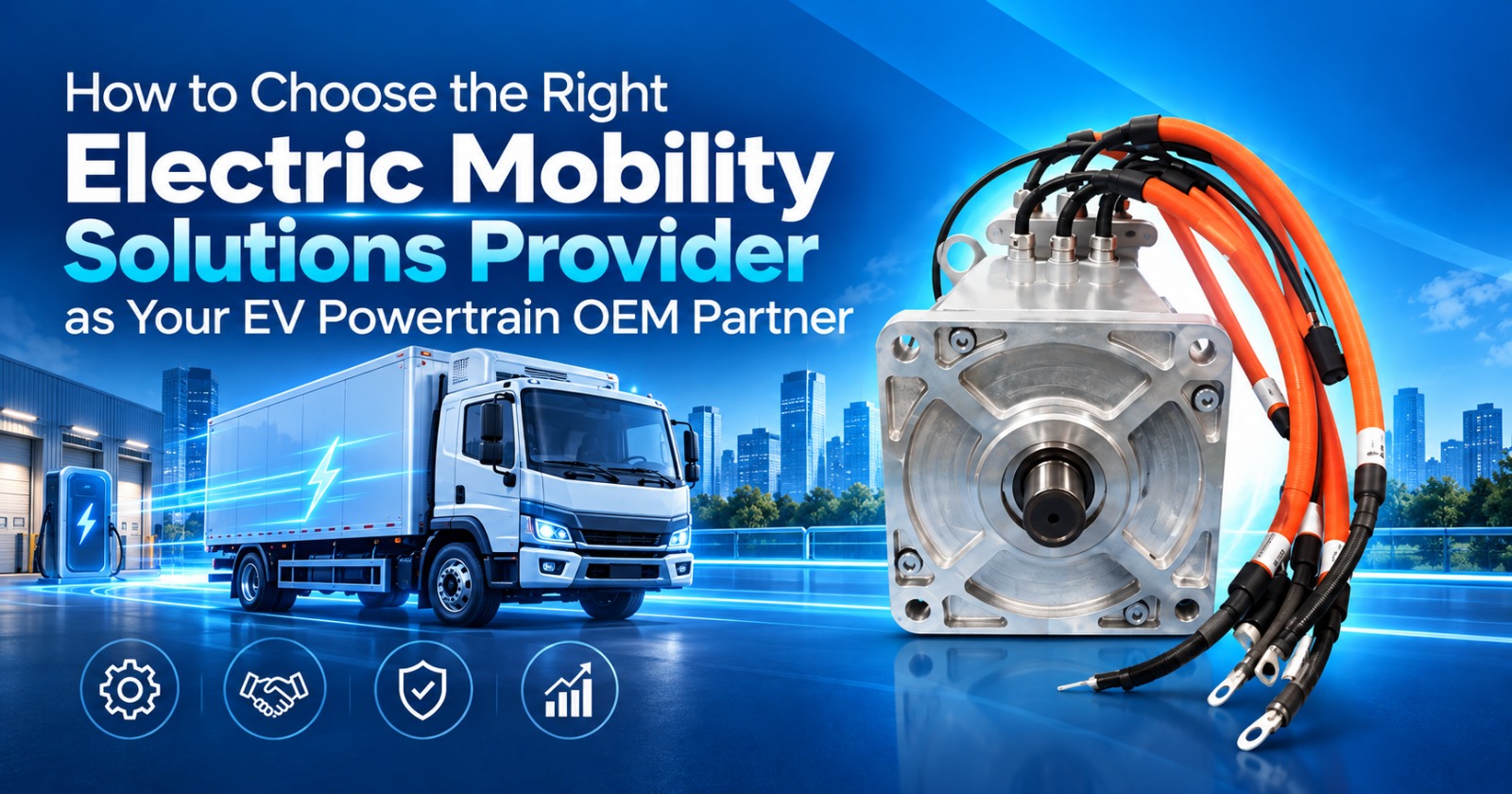
Choosing the right Electric Mobility Solutions Provider is one of the most consequential sourcing decisions in an EV program. Get it right and the partner becomes an engineering asset — helping you meet timelines, validate performance, and scale production. Get it wrong and the gap between what the supplier promised and what they can actually deliver shows up during development, launch, or in the field.
This guide gives you a structured, evidence-based framework for evaluating an EV powertrain partner — from engineering capability and quality systems through to validation, scalability, and lifecycle support.
Quick Answer: The right partner depends on your program's scope. Before evaluating any supplier, define what you need them to own — component manufacturing, subsystem delivery, or system-level integration. Then check whether the supplier has the engineering depth, quality management, manufacturing capability, validation evidence, traceability systems, and lifecycle support that match that responsibility.
Conventional automotive sourcing tends to focus on cost, capacity, and delivery reliability. EV powertrain sourcing adds several layers on top of that:
An Electric Mobility Solutions Provider needs to understand how these layers interact. A supplier that only machines metal may not have visibility into inverter switching losses. A supplier that only builds electronics may not understand rotor dynamics or bearing loads. Effective supplier selection depends on matching supplier capability to the program's defined responsibilities.
This is why the selection process should begin with a capability map, not a price comparison. A low initial quote may create additional costs if the supplier cannot support validation, compliance, scalability, or lifecycle requirements.
Not every supplier does the same job. Before you compare companies, it helps to know which type of supplier you are actually looking for.
Supplies individual parts — motor shafts, housings, pins, precision forgings, castings — to your design. Design responsibility stays with you or with a separate engineering partner. The supplier's role is precision manufacturing, quality compliance, and on-time delivery.
Delivers a defined subsystem such as a motor, inverter, or DC-DC converter. The supplier owns the performance and validation of that subsystem, but not the full vehicle integration. Clear interface agreements between OEM and supplier are essential at this level.
Supports integration across the motor, inverter, controller, reduction gearing, and thermal management. May also contribute control software and system-level validation. This is the most demanding model, requiring deep technical collaboration on both sides.
Knowing which type you need prevents mismatched expectations during supplier evaluation. For OEMs looking at electric drive system capabilities, GPP's E-Powertrain solutions cover motors, controllers, and DC-DC converters for high-voltage commercial and industrial applications.
This framework works for both first-time supplier qualification and periodic re-evaluation of existing partners. Each section includes the evidence to request — not just the questions to ask.
Start by writing down what the supplier is expected to own. If the scope includes design, ask for proof of engineering capability — not just a list of past projects.
Look for evidence of:
Evidence to request: Design responsibility matrix, sample DFMEA, simulation capability examples, description of prototype process, validation plan.
IATF 16949 is a key automotive quality-management certification to verify. It builds on ISO 9001 and adds automotive-specific requirements for product safety, risk management, embedded software, and sub-tier supplier control. GPP holds IATF 16949, ISO 14001:2015, ISO 45001:2018, and AS9100-D certifications.
Evidence to request: Current certificates with clearly stated scope, customer-specific requirements documentation, recent audit results, traceability examples.
A good design is only useful if it can be produced consistently. EV powertrain components require precision machining, controlled heat treatment, clean assembly, and rigorous testing.
Capabilities worth verifying include:
Evidence to request: Capacity calculations, equipment lists, process flow diagrams, bottleneck analysis, contingency plan.
Validation is a chain of evidence that shows a component or system will perform as intended under real conditions. The main validation areas for EV powertrain components include:
Evidence to request: Validation plan, representative test reports, failure analysis examples, correlation between simulation and physical testing.
ISO 26262 provides a risk-based framework for managing safety risks in electrical and electronic systems in road vehicles. For EV powertrains, functional safety requirements may apply to:
ISO/SAE 21434 provides a structured framework for managing cybersecurity risks across the vehicle E/E lifecycle. Where the supplier has software or control responsibilities, this should be part of the evaluation.
Evidence to request: Functional safety management plan, ASIL targets where applicable, safety case evidence, cybersecurity risk assessment approach, responsibility matrix.
Process capability tells you how consistently a manufacturing process meets specification. Traceability tracks a component from raw material through every manufacturing step to the finished product and into the field — enabling rapid containment if a defect is found in the field.
Evidence to request: Sample traceability record, SPC data, control plan, PFMEA summary, MSA report.
EV demand can shift quickly. A supplier that can deliver 10,000 units per year may struggle with 100,000. Scalability requires capacity, skilled workforce, and sub-tier supply chain strength. According to the IEA Global EV Outlook, EV demand growth continues across major markets — supply chain resilience is not an optional consideration.
Evidence to request: Capacity study, run-at-rate evidence, sub-tier supplier map, business continuity plan.
An EV powertrain program runs for years. A supplier needs to stay engaged from concept through aftermarket. Good program management includes:
Evidence to request: APQP plan, PPAP documentation, change management process description, lifecycle support plan.
| Evaluation Area | What to Verify | Evidence to Request | Why It Matters |
|---|---|---|---|
| Engineering and Design | Motor design, power electronics, control software, system integration | Design responsibility matrix, sample DFMEA, simulation examples | Determines problem-solving ability relative to scope |
| Automotive Quality | IATF 16949 scope, customer-specific requirements | Current certificate with scope, audit results | Confirms automotive process discipline |
| Manufacturing | CNC/VMC, forging, casting, heat treatment, cleanroom assembly | Capacity calculation, equipment list, process flow | Ensures the supplier can produce what it designs |
| Validation and Testing | CMM, dyno, burn-in, leak testing, metallurgy | Validation plan, representative test reports | Proves performance under real conditions |
| Functional Safety | Applicable ISO 26262 activities, ASIL-related requirements | Safety management plan, responsibility matrix | Relevant where supplier has functional-safety responsibilities |
| Process Capability | SPC, PFMEA, control plans, MSA, traceability | SPC data, control plan, sample traceability record | Prevents defects and enables rapid containment |
| Scalability | Capacity, run-at-rate, sub-tier supply chain, BCP | Capacity study, run-at-rate evidence | Protects production schedules from disruption |
| Program Management | APQP, PPAP, change management, lifecycle support | APQP plan, PPAP documentation | Ensures smooth execution from prototype to aftermarket |
Every supplier will say they can do the job. The difference is whether they can show you proof.
| Supplier Claim | Evidence to Request |
|---|---|
| "We have EV engineering capability" | Design responsibility matrix, engineering examples, simulation reports |
| "We are automotive quality certified" | Current certificate with scope, customer-specific requirements documentation |
| "We can scale to your volume" | Capacity study, run-at-rate evidence, sub-tier supplier map |
| "We have strong validation capability" | Validation plan, representative test reports, failure analysis examples |
| "We have full traceability" | Sample traceability record, SPC data, control plan |
| "We can support your launch" | APQP plan, PPAP documentation, program management structure |
| "We have functional safety experience" | Safety management plan, ASIL responsibility matrix, safety case evidence |
APQP (Advanced Product Quality Planning) is a structured process for planning product development from concept through production launch. It defines the activities, tools, and timing needed to develop a product that meets customer requirements.
PPAP (Production Part Approval Process) is the documentation package that proves a production process can consistently meet customer requirements. PPAP is submitted at defined levels agreed with the customer, typically before first production shipment.
In simple terms: APQP is the plan. PPAP is the proof. Both are standard in automotive supplier qualification and should be part of any EV powertrain sourcing process.
India has become a significant player in the global EV component supply chain. For OEMs sourcing in India, a few additional considerations are worth checking:
GPP (Ghaziabad Precision Products) combines its established precision-manufacturing capabilities with electric-drive technology and EV powertrain solutions. Headquartered in Ghaziabad, Uttar Pradesh, GPP has been supplying precision components since 1988 and operates five manufacturing facilities across India covering 37,500 square metres.
Engineering and R&D: DSIR-recognised R&D centre supporting design optimisation, finite element analysis, computational modelling, 3D printing, and rapid prototyping. Custom electric powertrain platforms for low, medium, and high-voltage applications including SR and PMSM motor designs.
Quality systems: IATF 16949, ISO 14001:2015, ISO 45001:2018, and AS9100-D certifications with VDA 6.3-based process assessment practices where applicable.
Manufacturing: CNC and VMC machining, automated forging and casting lines, induction hardening and nitriding, ultrasonic cleaning, and ISO 8 cleanroom assembly for controllers and power electronics.
E-Powertrain solutions: Motors, controllers (inverters), and DC-DC converters for high-voltage commercial vehicle and construction machinery applications, offered through GPP's relationship with Aradex, Germany — over 30 years in electric-drive technology. View GPP's E-Powertrain solutions.
Precision components: Precision forgings, precision castings, and shafts and pins for automotive and EV powertrain applications.
Validation: CMMs, tensile testing, eddy current sorting, metallurgical microscopy, burn-in testing for EV controllers, and 100% EOL dyno testing of applicable EV powertrain systems.
For more on GPP's manufacturing capabilities, see the facilities overview and company background.
An Electric Mobility Solutions Provider is a company that supplies components, systems, or engineering services for electric vehicles. This can range from precision parts like shafts and forgings to complete powertrain systems including motors, inverters, controllers, and DC-DC converters. The scope of responsibility depends on the supplier's capabilities and the OEM's sourcing strategy.
IATF 16949 is a key automotive quality-management certification to verify. Depending on the supplier's scope and responsibilities, additional requirements may apply for ISO 26262 functional safety, ISO/SAE 21434 cybersecurity, and environmental management. Always verify the certificate's scope and any customer-specific requirements before qualification.
Ask for a design responsibility matrix, evidence of motor or power-electronics design experience, simulation reports, and examples of prototype development. Request documentation showing how the supplier correlated simulation with physical test results. In-house simulation and validation capabilities are strong indicators of genuine engineering depth.
APQP (Advanced Product Quality Planning) is a structured process for planning product development from concept through production launch. PPAP (Production Part Approval Process) is the documentation package that demonstrates a production process can consistently meet requirements. APQP is the plan; PPAP is the proof. Both are standard requirements in automotive supplier qualification.
ISO 26262 is the international standard for functional safety of electrical and electronic systems in road vehicles. It defines requirements for managing safety risks, including ASIL classifications and safety goals. For EV powertrain components within its scope, alignment with ISO 26262 processes is important where the supplier has functional-safety responsibilities assigned by the OEM.
Traceability means tracking each component from raw material through every manufacturing step to the finished product and into the field. It is enabled by batch records, serial numbers, process data logging, and quality records. Effective traceability allows quick containment if a defect is found — critical for EV components given safety implications.
Key capabilities include precision machining, forging and casting, heat treatment, cleanroom assembly for electronics and controllers, and comprehensive testing such as CMM dimensional verification, dyno testing, burn-in, and leak testing. Multiple manufacturing locations provide additional capacity and supply chain resilience.
GPP combines precision manufacturing with electric-drive technology. It offers custom electric powertrain platforms, precision forgings, castings, shafts, and pins, with IATF 16949, ISO 14001, ISO 45001, and AS9100-D certifications. Its E-Powertrain solutions cover motors, controllers, and DC-DC converters for high-voltage applications through its partnership with Aradex, Germany. The exact engineering and supply scope depends on the customer program and agreed responsibilities.
Choosing the right Electric Mobility Solutions Provider is a multi-stage process that goes well beyond comparing quotes. The 8-point framework in this guide gives you a structured approach: define what the supplier needs to own, request evidence for each capability area, and evaluate the lifecycle commitment — not just the production capability at SOP.
The suppliers that work well as EV powertrain partners are those that understand both the technical requirements of electric drive and the process discipline of automotive manufacturing. Engineering capability without quality systems creates unpredictable output. Quality systems without engineering depth create a supplier that can comply but not solve problems.
For OEMs sourcing EV powertrain components or electric-drive systems in India, GPP combines precision manufacturing capabilities with selected electric-drive solutions and automotive quality processes. Review GPP's E-Powertrain solutions or contact the team with your application, voltage range, and sourcing requirements.