

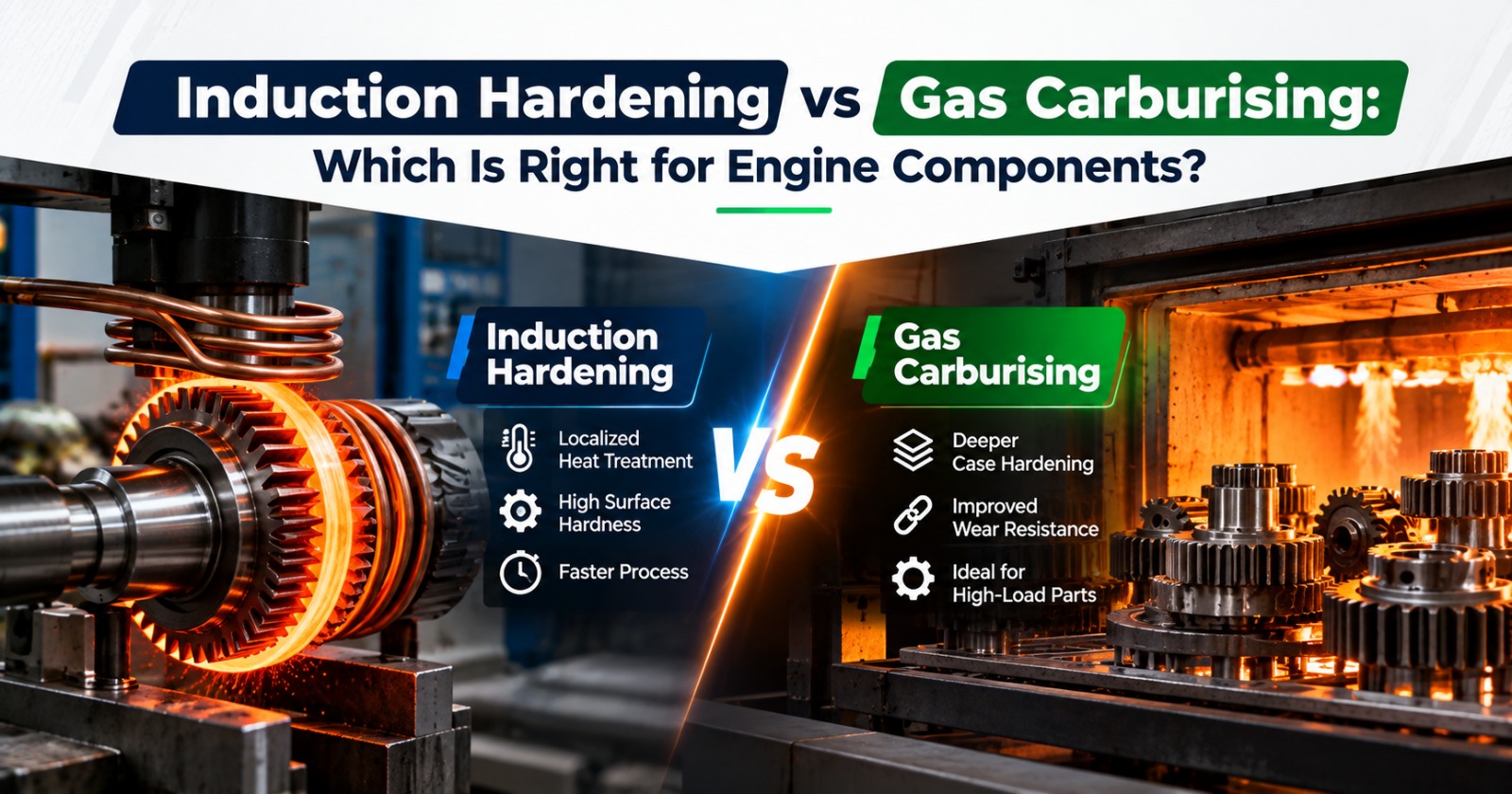
Induction hardening heats selected zones with an electric coil and then quenches them, giving a hard local layer with low distortion in short cycles. Gas carburising adds carbon to the whole surface of low-carbon steel in a furnace, giving a deeper, uniform case over longer cycles. The right choice depends on the part, steel grade, case depth and drawing, so confirm the method and records with your supplier.
An engine part needs two properties that pull in different directions. The surface must be hard so it resists wear. The core must be tough so it does not crack under shock. Heat treatment is how both are achieved in one piece of steel.
Induction hardening and gas carburising are two common methods. Both are used widely for components in commercial vehicle and off-highway engines.
Induction hardening uses a copper coil carrying high-frequency current to heat the surface of a part within seconds. A quench then locks in a hard layer. Because only the chosen zone is heated, the rest of the part stays largely unchanged and distortion is generally low.
This makes it a common choice for local wear areas, for example the ends of a push rod, journals on rocker shafts and wear zones on pins.
Gas carburising places low-carbon steel parts in a furnace with a carbon-rich atmosphere. Carbon diffuses into the surface, and a quench then hardens the case. The result is a deeper, more uniform hard layer all around the part.
It suits parts that need an even hard skin, such as tappets and valve lifters and certain shafts and pins.
| Factor | Induction Hardening | Gas Carburising |
|---|---|---|
| Heating method | Electric coil, local heating | Furnace with a carbon-rich atmosphere |
| Area treated | Selected zones | Whole surface |
| Case depth | Moderate, controlled by frequency and time | Deeper, controlled by time and carbon level |
| Cycle time | Seconds to minutes | Hours |
| Distortion risk | Generally low | Higher, so allowance is needed |
| Typical steel | Medium carbon or alloy steel | Low carbon or alloy case-hardening steel |
The drawing, the steel grade and the loading usually decide:
If you are unsure, ask the manufacturer for a process recommendation based on the drawing instead of fixing the method too early.
Shot peening is not a hardening method. It bombards the surface with small shot to create compressive stress, which delays crack growth. Springs and other fatigue-critical parts often receive it after forming and heat treatment, where the drawing calls for it.
After induction hardening, parts are typically checked for surface hardness, hardened length and case depth, and some are sectioned and etched to confirm the pattern. After carburising, hardness traverses and microstructure checks confirm the case. Visual checks look for cracks.
Which checks apply, and how often, depends on the drawing, control plan and customer requirements.
| Problem | Common Cause |
|---|---|
| Soft spots | Uneven heating or a dirty surface |
| Cracks | Sharp corners, wrong quench or a steel grade unsuited to the process |
| Distortion | Uneven heating and cooling, or residual stress from earlier steps |
| Shallow case | Short cycle time or low carbon level in the furnace |
Clear drawing notes and good process control remove most of these problems before parts reach the customer.
Heat treatment changes the size and shape of a part slightly. Critical surfaces are therefore left with a small allowance, then ground after hardening to restore the exact size and surface finish.
When heat treatment and machining are handled by the same manufacturer, allowances can be adjusted more quickly and batch results are easier to keep consistent.
Where the drawing or specification requires them, ask for:
Frameworks such as ISO 9001 and IATF 16949 describe how a supplier should control and record processes. Agree the record list with the supplier before the first order.
Ghaziabad Precision Products (GPP) was established in 1988 and operates five manufacturing facilities in Ghaziabad, Uttar Pradesh, with a combined footprint of approximately 37,500 sq. m. Its capabilities include forging, precision machining, heat treatment and finishing. The facilities page describes the equipment and processes in more detail. GPP supplies components to OEM and Tier-1 customers, and the clients page shows the sectors it serves.
Heat treatment is one of the capabilities GPP lists, and the facilities page describes the specific processes available. Confirm with GPP which method suits your part and which records apply to your drawing.
| GPP Capability | Buyer Benefit |
|---|---|
| Established in 1988 | A long operating history to review during supplier assessment |
| Five manufacturing facilities, approx. 37,500 sq. m. | A manufacturing network whose capacity can be discussed against your volume |
| Heat treatment among listed capabilities | Process and records can be discussed together with machining |
| Forging, precision machining and finishing | Allowance and grinding planned alongside heat treatment |
| Supplies OEM and Tier-1 customers | Experience with customer drawings and approval processes |
Induction hardening is a surface-hardening process in which a high-frequency coil heats a local zone of a steel part, followed by a fast quench. It produces a hard layer in the selected area while the rest of the part stays largely unchanged.
Gas carburising is a case-hardening process. Low-carbon steel parts are held in a furnace with a carbon-rich atmosphere so carbon diffuses into the surface, and a quench then hardens the case. It gives a deeper, more uniform hard layer than local heating methods.
Neither wins in every case. Induction hardening suits local wear zones and short cycles, while carburising suits an even, deeper case over the whole surface. The drawing, steel grade, case depth and distortion limits decide which is appropriate. Ask for a recommendation based on your drawing.
Distortion is generally low because only a small area is heated, but part geometry, quench control and residual stress from earlier operations still matter. Critical surfaces are usually left with an allowance and ground after hardening. Ask how allowance is set.
Case depth is the thickness of the hardened layer from the surface inward. It is checked on a sectioned sample or by a hardness traverse. The required depth and the method used to measure it are specified on the drawing.
Tempering reheats a hardened part to a lower temperature to reduce brittleness while keeping most of the hardness. The temperature and time depend on the material and the required properties, and they are normally defined in the specification. Ask for the tempering record.
Shot peening creates compressive stress in the surface, which delays crack initiation and growth and improves fatigue life under repeated loading. It is applied where the drawing requires it, usually after forming and heat treatment. It does not replace hardening, and its use depends on the specification.
Tappets, push rod ends, rocker shafts, pins, valve bridges and springs commonly receive some form of heat treatment. The exact process, hardness and case depth for each part come from the engine drawing and specification. Confirm requirements part by part against your drawing.
Heat treatment is among GPP's manufacturing capabilities, and the facilities page describes the processes. To discuss a requirement, send your drawing, material grade and hardness or case-depth needs through the GPP contact page. Volumes and schedules are agreed per requirement, and records can be discussed at the same time.
The right heat treatment depends on the part, the steel and the loading. Compare the two methods against your drawing, plan grinding allowance with machining, and agree which hardness and case depth records you expect.
To discuss heat treatment for a component, send the drawing, material grade, annual volume and technical requirements through the contact page, or review the full product range.