

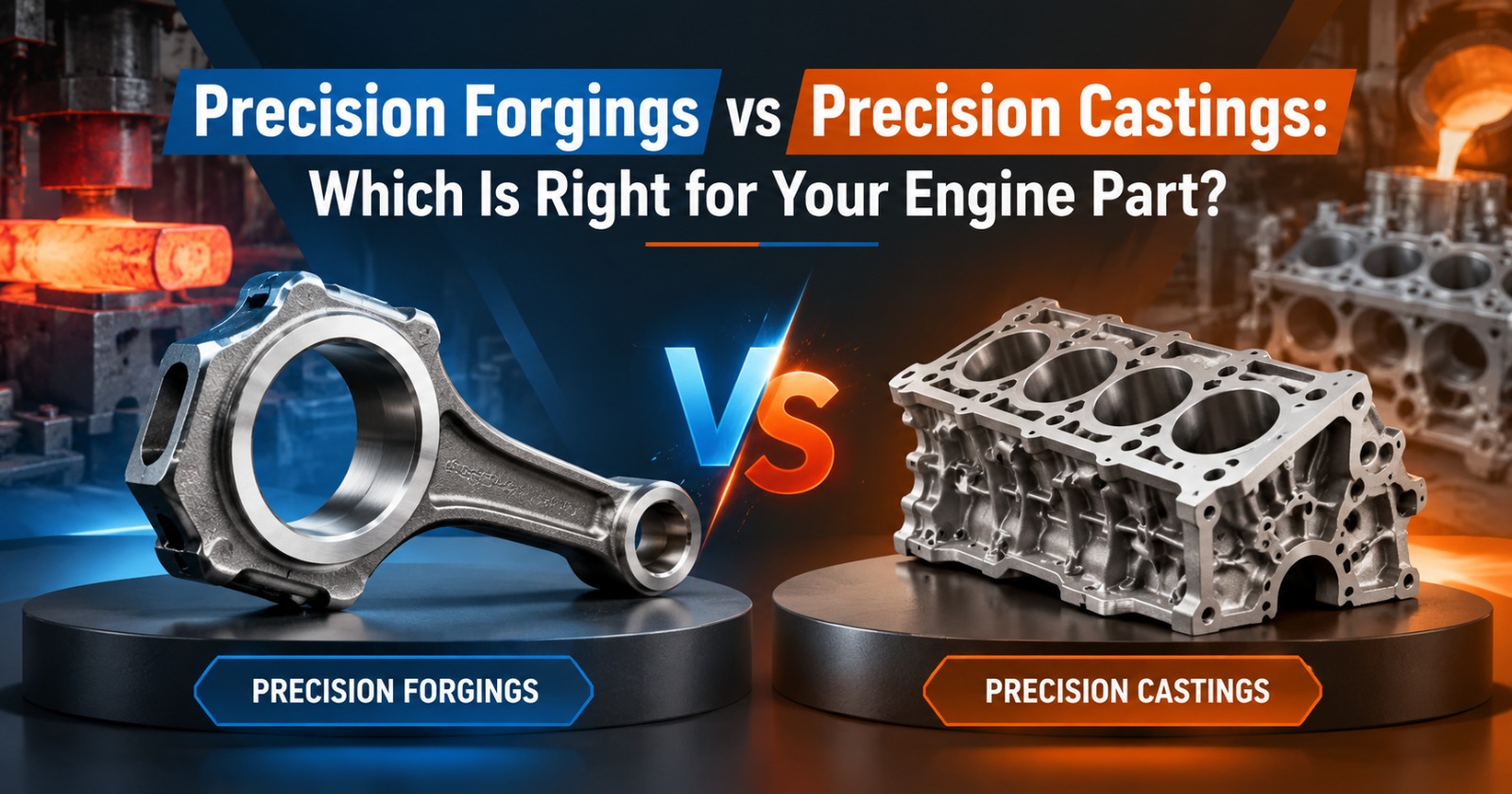
Choose precision forgings for parts that see shock, bending or repeated loading, because forging aligns the grain flow and generally gives higher strength and fatigue life. Choose castings for complex outlines, hollow sections or thin walls that are hard to forge. Both usually need machining and heat treatment afterwards, so involve the manufacturer early to settle machining allowance, tooling and quality checks.
Precision forgings are made by heating metal and pressing it in a die so it takes its final form. The pressing refines the internal grain and aligns it with the part contour, which is why forged parts generally handle shock and repeated loading better than most other forms.
Typical engine and chassis parts made this way are shown on the precision forgings page.
Casting pours molten metal into a mould and lets it solidify. It allows complex shapes, hollow sections and thin walls that are difficult to forge. Good foundry control keeps porosity low and surface quality consistent.
Parts where shape complexity is the main requirement are the usual fit for the precision castings route.
| Factor | Precision Forgings | Precision Castings |
|---|---|---|
| Strength and fatigue life | Generally higher, thanks to aligned grain flow | Good, but generally lower than forged in load-bearing use |
| Shape complexity | Moderate | High, including hollow sections |
| Internal defects | Rare | Porosity and shrinkage must be controlled |
| Typical use | Shafts, levers, bridges and other load-bearing parts | Housings, brackets and complex bodies |
| Tooling | Dies for each part | Patterns and moulds |
| Volume fit | Medium to high | Low to high |
Use these as starting rules, then confirm with the manufacturer:
Parts such as the valve bridge, U-bolts and many shafts and pins are typical candidates for forging because of the loads they carry. Housings and brackets often suit casting. Comparing the two routes early avoids costly redesign later, but the final choice follows the drawing, load case and volume.
Forged blanks are typically checked for size, weight, surface laps and, on sample cuts, grain flow. Hardness is checked after heat treatment. For load-bearing parts, cracks and folds are the main concern.
Cast blanks are checked for size, surface finish and internal soundness. Porosity and shrinkage cavities are the main risks, so foundry process control matters. In both cases, material certificates and batch identification support traceability. The checks that apply to your part depend on the drawing, control plan and customer specification.
| What to Check | What to Verify | Why It Matters |
|---|---|---|
| Process coverage | Forging, casting, machining and heat treatment: in-house or outsourced | Hand-offs add risk and complicate allowances |
| Tooling | Die and pattern design, ownership and maintenance | Affects consistency and lead time |
| Material records | Certificate for the specified grade | Confirms the starting material |
| Blank inspection | Size, surface and internal checks suited to the process | Catches defects before machining |
| Quality system | Framework such as ISO 9001 or IATF 16949 | Shows how processes are controlled |
| Sample approval | First-article report before volume production | Confirms the process against the drawing |
Bring the manufacturer in at the design stage. A forging engineer can suggest draft angles, parting lines and fillets that improve die life and part strength. A foundry engineer can suggest wall thickness and gating that reduce defects.
This also helps you decide whether forging, casting or a combined route with machining gives the best result for the part, and what the sample approval plan should look like.
Ghaziabad Precision Products (GPP) was established in 1988 and operates five manufacturing facilities in Ghaziabad, Uttar Pradesh, with a combined footprint of approximately 37,500 sq. m. Its capabilities include forging, precision machining, heat treatment and finishing. The facilities page describes the equipment and processes in more detail. GPP supplies components to OEM and Tier-1 customers, and the clients page shows the sectors it serves.
GPP's product range includes both precision forgings and precision castings, with machining and heat treatment also available, so blanks and finished parts can be discussed with one manufacturer. A Ghaziabad base also makes plant visits and sample reviews practical for buyers in Delhi-NCR, and buyers elsewhere in India can request a virtual audit.
| GPP Capability | Buyer Benefit |
|---|---|
| Established in 1988 | A long operating history to review during supplier assessment |
| Five manufacturing facilities, approx. 37,500 sq. m. | A manufacturing network whose capacity can be discussed against your volume |
| Precision forgings and precision castings in the product range | Process options that can be compared for the same part |
| Forging, precision machining, heat treatment and finishing | Blank, machining and heat treatment discussed together |
| Supplies OEM and Tier-1 customers | Experience with customer drawings and approval processes |
They are parts shaped by pressing heated metal in a die to a near-final form. The process refines and aligns the grain, which generally improves strength and fatigue life. Forged blanks usually still go through machining and heat treatment before they become finished components.
In most load-bearing uses, yes. Forging aligns grain flow and avoids the internal voids that casting can leave, which helps with shock and fatigue. Castings can still be good for parts with complex shapes and lower loads, so the load case should decide.
Choose casting when the part has a complex outline, internal cavities or thin walls that would be hard to forge. Housings and brackets are typical examples. Confirm porosity control and inspection requirements with the foundry before approving the process. Review porosity limits too.
Hot forging heats metal above its recrystallisation temperature so it flows easily into the die and refines its internal structure. It is used for parts that need strength and fatigue resistance, and the forged blank is then machined and heat treated as the drawing requires.
Usually yes. Forging leaves a machining allowance on critical surfaces, which is then removed by turning, grinding or milling. The allowance should be agreed early so the finished part meets the drawing without scrap. Agree allowance before tooling is finalised, since changing it later is costly.
It means the forged or cast blank is already close to the final size, so less material is removed during machining. This can save material and machining time, but the achievable shape and tolerance depend on the part design and process.
Yes. Many castings are heat treated to reach the required hardness and toughness. The method depends on the material and the drawing, so specify the requirement and ask the supplier how it is controlled and recorded. Request hardness records where specified.
Commercial vehicles, tractors, construction equipment, rail, hydraulics and power generation all use forged components. These sectors tend to specify load-bearing parts where strength and fatigue life matter, and each sets its own material and inspection requirements. Parts typically include shafts, bridges and structural components.
GPP's product range includes precision forgings and precision castings, alongside machining and heat treatment. To discuss which route suits your part, send your drawing, material grade and annual volume through the GPP contact page. Volumes and schedules are agreed per requirement.
There is no single winner between forging and casting. The better choice follows the load, shape and volume of the part, and the machining and heat treatment that come after it.
For a process discussion on your part, send the drawing, material grade, annual volume and technical requirements through the contact page. You can also review the full product range.